Por Tatiana Goncharova -Татьяна Гончарова-
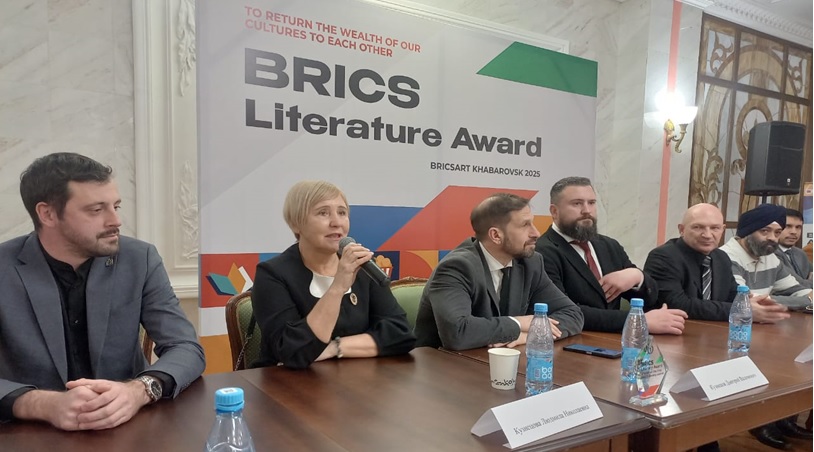
Dic. 1/25.-El 30 de noviembre de 2025 se anunció en Jabárovsk el nombre de la primera galardonada con el Premio de Literatura BRICS. Tras la votación del jurado internacional, el premio fue otorgado a la escritora egipcia Salwa Bakr, una de las figuras más destacadas de la prosa árabe contemporánea, autora de siete colecciones de relatos breves, siete novelas y una obra de teatro, cuyas obras han sido traducidas a numerosos idiomas europeos.
La ceremonia oficial de anuncio de la ganadora se celebró en el Palacio de la Cultura de la Ciudad de Jabárovsk, en el marco del Festival de las Artes de los Países BRICS, que tuvo lugar en Jabárovsk del 26 al 30 de noviembre y se convirtió en su evento principal. La Sala Pequeña del Palacio reunió a representantes de la administración del Territorio de Jabárovsk, diplomáticos, escritores, editores y figuras públicas de los países BRICS y de Estados socios. La ceremonia de entrega del premio a la ganadora tendrá lugar en un futuro próximo; la fecha y el lugar se anunciarán más adelante. La ganadora recibirá un premio en metálico de 1 millón de rublos.
(Le puede interesar:
– Aniversario Acuerdos de Paz; J. Manuel, en..; situación en aguas del Caribe; Somalia, al borde del abismo; a juicio militares; cooperación china/Colombia; USA, Amenaza la paz (VIDEO)
–Democratización de la Pauta Oficial. Todo sobre el: IAD Medios de Comunicación Alternativos, Comunitarios y Digitales (VIDEO) ,
–J. Manuel, en..: “La Primera Piedra” (VIDEO)
–Arma del Imperio: el doble rasero de la guerra contra el narco ,
–EPM lanzó el Sandbox Gas: innovación y tecnología para transformar el servicio de gas natural ,
– SE EXTINGUE LA VIDA de J, Manuel, por culpa n-EPS y criminales varios
-¿Revoluciones en las urnas o en las calles? )
 La ceremonia oficial de anuncio de la ganadora se celebró en el Palacio de la Cultura de la Ciudad de Jabárovsk, en el marco del Festival de las Artes de los Países BRICS, que tuvo lugar en Jabárovsk del 26 al 30 de noviembre y para el cual se convirtió en el evento central. La Sala Pequeña del Palacio reunió a representantes de la administración del Territorio de Jabárovsk, diplomáticos, escritores, editores y figuras públicas de los países BRICS y de Estados socios. La entrega del premio a Salwa Bakr tendrá lugar en un futuro próximo; la fecha y el lugar se anunciarán por separado. La ganadora recibirá un premio en metálico de 1 millón de rublos.
Importancia del premio y de la victoria
Al dirigirse a los participantes, el presidente de la Unión Rusa de Editores, presidente de la Asociación de Abogados de Rusia y miembro del Consejo de Administración del Premio por parte de Rusia, Serguéi Stepashin, subrayó el carácter histórico del acontecimiento y el papel de los BRICS en la agenda cultural mundial:
«Hoy estamos siendo testigos de un momento verdaderamente histórico. No solo anunciamos el nombre de una ganadora, sino que colocamos la primera piedra de un espacio cultural común para nuestros países. Este premio es una poderosa señal para el mundo de que la literatura de los países BRICS es una parte integral y vibrante de la cultura global.
Felicito de todo corazón a la primera ganadora del Premio de Literatura BRICS, la talentosa escritora egipcia Salwa Bakr. Esta victoria es un reconocimiento a su extraordinario talento y una prueba de que la literatura de los países BRICS se hace oír con voces nuevas y vigorosas. Salwa Bakr se ha convertido en una pionera cuya obra marca un alto estándar para los futuros galardonados.
Espero que esta victoria marque el inicio de una larga y gloriosa historia de reconocimiento literario, no solo en el marco de los BRICS, sino también a escala mundial. Estoy convencido de que el Premio de Literatura BRICS ocupará su lugar legítimo entre las principales distinciones internacionales y se convertirá en un faro que señale el camino hacia las verdaderas joyas de la literatura mundial».
Su compatriota, la escritora egipcia y miembro del Parlamento egipcio Doha Mustafa Assi, quien participó en la ceremonia en formato virtual y es una de las fundadoras del Premio, así como miembro del Consejo de Administración del Premio por parte de Egipto, la felicitó:
«El primer Premio de Literatura BRICS, y este año Egipto es el país ganador. Para nosotros, esto es una gran alegría y una noticia muy importante. Salwa Bakr es una escritora egipcia verdaderamente especial, poco convencional. Tiene una voz propia, singular, que no se parece a la de nadie. Siempre lo hemos sentido al leer sus libros, y nos alegra mucho que ahora esto se reconozca a tal nivel.
Creo que esto es solo el comienzo: el primer año del premio, la primera victoria para Egipto, la primera distinción BRICS para Salwa Bakr. Ella ha ganado, y me alegro sinceramente por ello».
Perspectiva internacional y papel de Jabárovsk
Kumar Karan, vicecónsul del Consulado General de la República de la India en Vladivostok, subrayó la importancia del Krai de Jabárovsk como sede del premio y del foro de los BRICS:
«La ceremonia de hoy en Jabárovsk se desarrolló de manera excelente. La elección del Krai de Jabárovsk como sede de la fase final del Premio de Literatura BRICS subraya su papel especial como puerta de entrada de Rusia al Lejano Oriente y como importante puente cultural entre los países BRICS. Celebrar aquí la primera ceremonia de entrega del premio es algo más que un gesto simbólico: la región ha estado históricamente vinculada al diálogo intercultural y ahora se está convirtiendo en una de las plataformas clave para la cooperación humanitaria entre los países de la mayoría global.
El Premio BRICS desempeña un papel importante en el fortalecimiento del diálogo intercultural entre nuestros países. Su misión es apoyar a las voces literarias contemporáneas que promueven los valores tradicionales y espirituales, fomentar las traducciones, las publicaciones interculturales y aquellas obras que reflejan el patrimonio común y la diversidad de los pueblos de los BRICS.
Miramos al futuro con gran atención. El tercer foro BRICS sobre “Valores tradicionales” se celebrará en la India, y será allí donde se presente la lista larga del Premio de Literatura BRICS 2026. Para nosotros, esto no es solo un honor, sino también una oportunidad para profundizar aún más la cooperación cultural, que sirve de base para el fortalecimiento de los vínculos políticos, económicos y humanos entre los países de la asociación».
Premio Especial y comentarios desde Indonesia
El Premio Especial «Por la innovación en la literatura» fue otorgado al escritor indonesio Denny JA. Esta distinción le fue concedida por su contribución al surgimiento y desarrollo del género del ensayo poético, que combina en una misma obra elementos líricos y narrativos con material factual.
La coordinadora nacional de la Red de Literatura BRICS en Indonesia, Sastri Bakry, expresó su orgullo por el hecho de que, en la primera edición del premio, hayan sido reconocidos tanto Egipto como Indonesia:
«Estoy muy orgullosa de la escritora egipcia Salwa Bakr, que siempre habla en nombre de las mujeres y lucha incansablemente por la igualdad de género a través de sus textos. También me enorgullece que Denny haya recibido el “Premio Especial por la Innovación en la Literatura”. Denny realmente lo merece y, casi sin darse cuenta, ya ha elevado la imagen de Indonesia ante los ojos de todo el mundo».
Premio de Literatura BRICS: una nueva alternativa al Premio Nobel de Literatura
En su intervención durante la ceremonia, Dmitri Kuznetsov, diputado de la Duma Estatal de la Federación de Rusia, miembro del Comité de Asuntos Internacionales y jefe de la Secretaría del Premio, expuso la misión y los principios de esta nueva distinción:
«Es difícil no estar de acuerdo con Vladímir Medinski, Mijaíl Razvozháev y Zajár Prilepin en que el actual Premio Nobel de Literatura a menudo muestra signos de politización y se aleja de los verdaderos criterios del arte. No solo nuestro país, sino el desarrollo de la cultura humana en su conjunto, necesita un nuevo galardón internacional de prestigio que promueva los valores de la mayoría global —el respeto mutuo, el humanismo y la justicia — y que sea capaz de reconocer debidamente la profundidad, el talento y la contribución de los escritores a la cultura mundial. Nosotros —el equipo de Zajár Prilepin y nuestros colegas afines de la Unión Rusa del Libro, la Unión de Escritores de Rusia y otros países— hemos creado tal institución de reconocimiento en la forma del Premio de Literatura BRICS.
Estoy profundamente convencido de que este no debe ser un premio exclusivamente ruso, sino el resultado del trabajo colectivo de las comunidades literarias de los países de la mayoría global. Por iniciativa del secretario de la Asociación de Escritores de China, el camarada Hu Bangsheng, hemos creado la Asociación de Uniones de Escritores y Organizaciones Literarias —la Red de Literatura BRICS— que asumirá esta responsabilidad compartida».
Kuznetsov felicitó a Salwa Bakr por su victoria y señaló que siguió de cerca la votación de los jurados nacionales: el candidato ruso, Alexéi Varlámov, estuvo entre los principales aspirantes y recibió votos, en particular, de la India y de los Emiratos Árabes Unidos, pero finalmente los votos decisivos llegaron de otros países.
Hablando sobre el futuro del premio, añadió que la principal intriga de la próxima edición está vinculada a las decisiones de la Red de Literatura BRICS en relación con las normas futuras del galardón: «Estamos solo al comienzo de una enorme empresa, pero estamos seguros de que tendrá éxito».
Resultados de la primera edición del Premio de Literatura BRICS
Vadim Teriójin, copresidente de la Asociación de Escritores de la Red de Literatura BRICS, resumió los resultados de la primera edición y esbozó las perspectivas de desarrollo de la red:
«La primera edición del Premio de Literatura BRICS ha llegado a su fin. Felicitamos calurosamente a la galardonada de Egipto, Salwa Bakr, por su victoria. Es un gran honor para nosotros ser pioneros de una distinción internacional tan prestigiosa, que ofrece a los escritores la oportunidad de asegurar un lugar en la historia de la literatura mundial.
Durante el último año hemos recorrido juntos un largo camino creativo. Hubo muchos debates y discusiones. Cada país BRICS expuso su visión del desarrollo de la Red de Literatura BRICS y del proceso literario mundial. Muchos Estados amigos y países socios expresaron su deseo de unirse a nosotros y participar activamente en la próxima edición.
No vemos nuestra organización como una estructura cerrada destinada únicamente a los países BRICS. Esperamos que en el futuro todos los escritores que compartan nuestros valores estéticos y ético‑espirituales puedan participar en nuestro trabajo. Ya es evidente que la Red de Literatura BRICS tiene un gran potencial y contribuirá al enriquecimiento mutuo de las literaturas nacionales y a la unidad de los pueblos a través de la palabra escrita».
Sobre el Premio de Literatura BRICS y el procedimiento de selección
El Premio de Literatura BRICS es una nueva distinción internacional creada en noviembre de 2024 en el marco del foro BRICS «Valores tradicionales». El premio apoya a autores contemporáneos cuyas obras reflejan los valores culturales y espirituales de los pueblos de los países BRICS y fomenta la traducción y publicación de literatura en las lenguas de los Estados participantes y de los países de la mayoría global.
Para organizar el Premio de Literatura BRICS se creó una dirección en cada país y se formó un jurado nacional encargado de nominar a candidatos que hayan hecho una contribución significativa al desarrollo de la literatura. La lista larga se publicó en Brasil. Tras un mes de votaciones, quedaron 10 finalistas —uno por cada país—, y la lista corta se presentó en Yakarta, Indonesia.
La lista corta incluyó a la escritora brasileña Ana Maria Gonçalves; al escritor y poeta indio Sonu Saini; al escritor, columnista y bloguero chino Ma Boyong; a la escritora, periodista e investigadora cultural emiratí Reem Al Kamali; al escritor, político y figura pública etíope Abere Adamu; a la escritora y poeta sudafricana Ntabiseng JahRose Jafta; al escritor indonesio Denny JA; al escritor y publicista ruso Alexéi Varlámov; y al escritor y poeta iraní Mansour Alimoradi. Egipto estuvo representado por la escritora Salwa Bakr.
Sobre la galardonada
Salwa Bakr (nacida en 1949, El Cairo) es una reconocida escritora, novelista y crítica egipcia. Se graduó en la Universidad Ain Shams, trabajó como crítica de cine y teatro para destacados medios árabes y fue profesora en la Universidad Americana de El Cairo.
Sus obras —entre ellas las novelas El carro dorado (The Golden Chariot) y El hombre de Bashmur (The Man from Bashmour), esta última incluida en la lista de las 100 mejores novelas árabes— se centran en los destinos de los desfavorecidos y marginados, así como en la situación de la mujer en la sociedad egipcia.
Salwa Bakr es ganadora del premio literario de Deutsche Welle y miembro del Consejo Supremo de Cultura de Egipto y de la Unión de Escritores de Egipto. Su victoria en la edición inaugural del Premio de Literatura BRICS consolida aún más su condición de una de las voces más significativas de la literatura mundial contemporánea.
…………………………………………………….
IN ENGLISH
Egyptian writer Salwa Bakr becomes the first laureate of the BRICS Literature Award
On 30 November 2025, the name of the first laureate of the BRICS Literature Award was announced in Khabarovsk. Following the vote of the international jury, the award went to Egyptian writer Salwa Bakr — one of the leading figures in contemporary Arabic prose, the author of seven short-story collections, seven novels and a play, whose works have been translated into numerous European languages.
The official ceremony announcing the winner was held at the Khabarovsk City Palace of Culture as part of the BRICS Countries Arts Festival, which took place in Khabarovsk from 26 to 30 November and became its key event. The small hall of the Palace brought together representatives of the Khabarovsk Territory administration, diplomats, writers, publishers and public figures from BRICS countries and partner states. The award ceremony for the winner will take place in the near future — the date and venue will be announced later. The winner will receive a cash prize of 1 million rubles.
The official ceremony announcing the winner was held at the Khabarovsk City Palace of Culture as part of the BRICS Countries Arts Festival, which took place in Khabarovsk from 26 to 30 November and for which it became the key event. The Small Hall of the Palace brought together representatives of the Khabarovsk Territory administration, diplomats, writers, publishers and public figures from BRICS countries and partner states. The presentation of the award to Salwa Bakr will take place in the near future, with the date and venue to be announced separately. The winner will receive a cash prize of 1 million rubles.
Significance of the award and the victory
Addressing the participants, President of the Russian Book Union, Chairman of the Association of Lawyers of Russia and member of the Award Board of Directors from Russia, Sergey Stepashin, emphasized the historic nature of the event and the role of BRICS in the global cultural agenda:
“Today we are witnessing a truly historic moment. We are not merely announcing a winner — we are laying the cornerstone for a shared cultural space for our countries. This award is a powerful signal to the world that the literature of the BRICS countries is an integral and vibrant part of global culture.
I wholeheartedly congratulate the first winner of the BRICS Literature Award — the talented Egyptian writer Salwa Bakr. This victory is a recognition of her outstanding talent and proof that BRICS literature is making itself heard with new, strong voices. Salwa Bakr has become a trailblazer whose work sets a high standard for future laureates.
I hope this victory will mark the beginning of a long and glorious history of literary recognition — not only within the BRICS framework, but worldwide. I am confident that the BRICS Literature Award will take its rightful place among leading international distinctions and become a beacon pointing the way to the true gems of world literature”.
Her compatriot, Egyptian writer and member of the Egyptian Parliament Doha Mustafa Assi, who took part in the ceremony online and is one of the founders of the Award as well as a member of the Award’s Board of Directors from Egypt, congratulated her:
“The first BRICS Literature Award — and this year Egypt is the winner. For us, this is a great joy and very important news. Salwa Bakr is a truly special, unconventional Egyptian writer. She has her own distinctive voice, unlike anyone else’s. We have always felt this while reading her books, and we are very pleased that this is now recognized at such a level.
I believe this is only the beginning: the first year of the award, the first victory for Egypt, the first BRICS distinction for Salwa Bakr. She has won — and I am sincerely happy”.
International perspective and Khabarovsk’s role
Kumar Karan, Vice-Consul of the Consulate General of the Republic of India in Vladivostok, emphasized the importance of Khabarovsk Krai as a venue for the award and the BRICS forum:
“Today’s ceremony in Khabarovsk went excellently. The choice of Khabarovsk Krai as the venue for the finals of the BRICS Literary Award underlines its special role as Russia’s Far Eastern gateway and an important cultural bridge between the BRICS countries. Holding the first award ceremony here is more than symbolic: the region has historically been linked to intercultural dialogue and is now becoming one of the key platforms for humanitarian cooperation among the countries of the global majority.
The BRICS Award plays an important role in strengthening intercultural dialogue between our countries. Its mission is to support contemporary literary voices that promote traditional and spiritual values, to encourage translations, cross-cultural publishing, and those works that reflect the shared heritage and diversity of the peoples of BRICS.
We are looking to the future with great attention. The third BRICS ‘Traditional Values’ forum will be held in India, and it is there that the longlist for the 2026 BRICS Literature Award will be presented. For us, this is not just an honor, but also an opportunity to further deepen cultural cooperation, which serves as a foundation for strengthening political, economic and human ties between the countries of the association”.
Special Prize and Comments from Indonesia
The Special Prize “For Innovation in Literature” was awarded to Indonesian writer Denny JA. This distinction was conferred on him for his contribution to the emergence and development of the poetic essay genre, which combines lyrical and narrative elements with factual material in a single work.
The National Coordinator of the BRICS Literature Network in Indonesia, Sastri Bakry, expressed her pride in the fact that, in the first season of the award, both Egypt and Indonesia were recognized:
“I am very proud of the Egyptian writer Salwa Bakr, who always speaks on behalf of women and tirelessly fights for gender equality through her texts. I am also proud that Denny received the ‘Special Prize for Innovation in Literature’. Denny truly deserves it and, without even realizing it, he has already raised Indonesia’s profile in the eyes of the whole world”.
BRICS Literature Award: A New Alternative to the Nobel Prize in Literature
Speaking at the ceremony, Dmitry Kuznetsov, member of the State Duma of the Russian Federation, member of the Committee on International Affairs and Head of the Award Secretariat, outlined the mission and principles of the new distinction:
“It is hard not to disagree with Vladimir Medinsky, Mikhail Razvozhayev and Zakhar Prilepin that the modern Nobel Prize in Literature often shows signs of politicization and departs from the true criteria of art. Not only our country, but the development of human culture as a whole, needs a new authoritative international award that promotes the values of the global majority — mutual respect, humanism and justice — and is capable of duly recognizing the depth, talent and contribution of writers to world culture. We — the team of Zakhar Prilepin and our like‑minded colleagues from the Russian Book Union, the Writers’ Union of Russia and other countries — have created such an institution of recognition in the form of the BRICS Literature Award.
I am deeply convinced that this should not be an exclusively Russian award, but the result of the collective work of literary communities from the countries of the global majority. On the initiative of the Secretary of the Chinese Writers’ Association, Comrade Hu Bangsheng, we have established the Association of Writers’ Unions and Literary Organizations — the BRICS Literature Network — which is to assume this shared responsibility”.
Kuznetsov congratulated Salwa Bakr on her victory and noted that he had closely followed the voting of the national juries: the Russian nominee, Alexei Varlamov, was among the frontrunners and received votes, in particular, from India and the UAE, but in the end the decisive votes came from other countries.
Speaking about the future of the award, he added that the main intrigue of the next season is linked to the decisions of the BRICS Literature Network regarding the further rules of the Award: “We are only at the beginning of an enormous undertaking, but we are confident that we will succeed”.
Results of the first season of the BRICS Literature Award
Vadim Teryokhin, Co-Chair of the Writers’ Association of the BRICS Literature Network, summed up the results of the first season and outlined the prospects for the network’s development:
“The first season of the BRICS Literature Award has come to an end. We warmly congratulate the laureate from Egypt, Salwa Bakr, on her victory. It is a great honor for us to be the pioneers of such a prestigious international distinction, which offers writers a chance to secure a place in the history of world literature.
Over the past year, we have travelled a long creative road together. There were many debates and discussions. Each BRICS country set out its vision for the development of the BRICS Literature Network and for the global literary process. Many friendly states and partner countries expressed their wish to join us and take an active part in the next season.
We do not see our organization as a closed structure intended only for BRICS countries. We hope that in the future all writers who share our aesthetic and moral‑spiritual values will be able to take part in our work. It is already clear that the BRICS Literature Network has great potential and will contribute to the mutual enrichment of national literatures and to the unity of peoples through the written word”.
About the BRICS Literature Award and the selection procedure
The BRICS Literature Award is a new international distinction established in November 2024 at the BRICS forum “Traditional Values”. The award supports contemporary authors whose works reflect the cultural and spiritual values of the peoples of the BRICS countries and promotes the translation and publication of literature in the languages of the participating states and the countries of the global majority.
To organize the BRICS Literature Award, a directorate was set up in each country and a national jury was formed to nominate candidates who have made a significant contribution to the development of literature. The longlist was published in Brazil. After a month of voting, 10 finalists remained — one from each country; the shortlist was presented in Jakarta, Indonesia.
The shortlist included Brazilian writer Ana Maria Gonçalves; Indian writer and poet Sonu Saini; Chinese writer, columnist and blogger Ma Boyong; Emirati writer, journalist and cultural researcher Reem Al Kamali; Ethiopian writer, politician and public figure Abere Adamu; South African writer and poet Ntabiseng JahRose Jafta; Indonesian writer Denny JA; Russian writer and publicist Alexei Varlamov; and Iranian writer and poet Mansour Alimoradi. Egypt was represented by writer Salwa Bakr.
About the laureate
Salwa Bakr (born 1949, Cairo) is a renowned Egyptian writer, novelist and critic. She graduated from Ain Shams University, worked as a film and theatre critic for leading Arab media outlets, and taught at the American University in Cairo.
Her works — including the novels The Golden Chariot and The Man from Bashmour, the latter included in the list of the 100 best Arabic novels — focus on the destinies of the deprived and marginalized, as well as on the situation of women in Egyptian society.
Salwa Bakr is a recipient of the Deutsche Welle literary prize and a member of the Supreme Council for Culture of Egypt and the Egyptian Writers’ Union. Her victory in the inaugural BRICS Literature Award further cements her status as one of the significant voices in contemporary world literature.
48 views